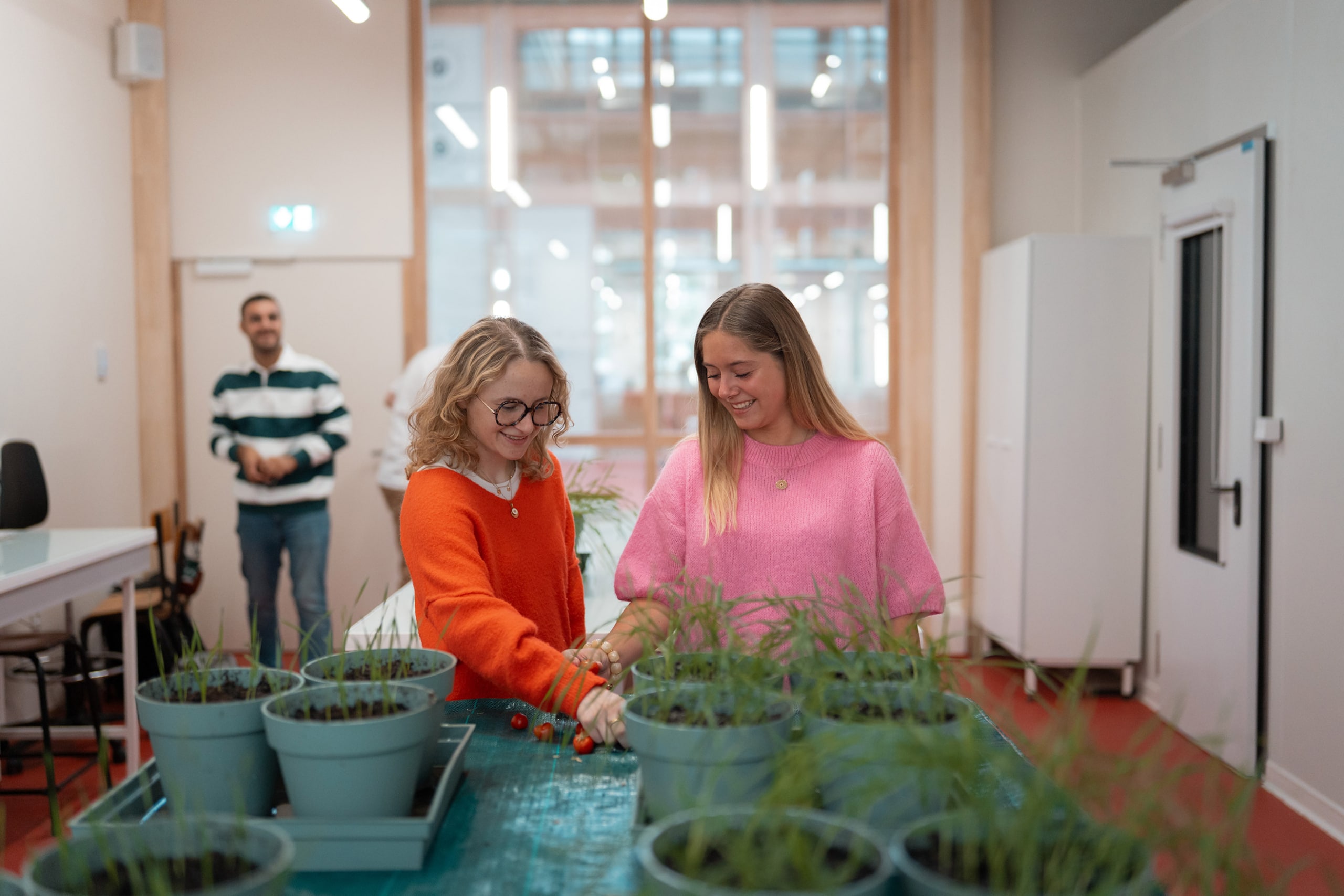
Alexandre Rigal, CEO of JUNIA, speaks to CCI France
15 July 2026
At the invitation of CCI France, Alexandre Rigal presented JUNIA’s vision as a strategic partner to businesses amid industrial, digital, and environmental transitions.
Speaking to CCI France, Alexandre Rigal, CEO of JUNIA, discussed the industrial, digital, environmental, and societal transitions that companies and regions are currently undergoing. In light of these changes, he emphasized the need for partners capable of providing long-term support for the transformations underway.
JUNIA positions itself as a strategic player in this process, drawing on training, innovation, and applied research.
Continuing education programs tailored to economic realities
With locations in Lille, Bordeaux, and Châteauroux, the school offers continuing education programs tailored to the economic realities of businesses, their needs for skills development, and changes in the workplace.
A Strong Local Presence Supporting Businesses
Thanks to its strong local presence, scientific expertise, and close ties to the professional world, JUNIA trains employees who are ready to tackle the challenges of today and tomorrow.
On Thursday, October 16, 2025, JUNIA presented its new strategy for 2035 during a press conference led by Alexandre Rigal, the school’s president. Titled JUNIA2035 – Transformation(s), this roadmap marks a new phase in the engineering school’s development.
A History, a Legacy, and a Vision for the Future
“JUNIA is a history, a legacy, but also a vision for the future,” Alexandre Rigal noted in his opening remarks. Born from the merger of three prestigious engineering schools, JUNIA today embodies an engineering model rooted in tradition yet focused on innovation and the transitions ahead. This strategy is part of a ten-year plan: ten years to grow alongside our partners, support the systemic transitions our world is undergoing, and prepare for the school’s 150th anniversary. A single guiding principle drives this approach: “How do we want to be of service?”
Three Key Areas for Sustainable Transformation
The result of a collaborative effort involving more than 270 contributors, JUNIA2035 is structured around three main areas:
To train a new generation of engineers who are active agents, capable of combining technical excellence with societal impact
Bringing science and society together by making research accessible, visible, and useful to everyone
Strengthen JUNIA’s role as an economic and social actor serving local communities and the public interest
« L’ingénieur de demain ne sera pas seulement un expert technique, mais un passeur d’innovation capable de relier sciences et société, et de donner ainsi du sens à son métier. »
A school that is changing because the world is changing
For JUNIA, a modern engineering school is one that is rooted in technology and proud to embrace it. It is also a school that is evolving, because the world is changing—and its role is to understand these changes in order to better support them. This vision is already taking shape today through several key initiatives:
a three-year educational reform to reinvent engineering programs;
the launch of an educational network focused on artificial intelligence;
the opening of an educational innovation center on the Bordeaux campus.
Supporting businesses, regions, and major transitions
JUNIA aims to be a key player in the energy, digital, and environmental transitions. Working alongside businesses, regions, and citizens, the school seeks to train engineers who are active agents of change and catalysts for innovation, capable of bringing about sustainable transformation in society. Through JUNIA2035 – Transformation(s), the school reaffirms its ambition: to train engineers who are active agents, serving businesses, regions, and the major transitions.
Whether you’re a scientist, a creative, a curious person, or someone who wants to make a difference, there are many ways to join JUNIA, depending on your skill level and learning style.
Why take a prep course at JUNIA?
Choosing an integrated prep program at JUNIA means choosing a path that truly suits you. Right after high school, you’ll join a renowned engineering school, with a prep program designed to adapt to your profile, your interests, and your goals. Here, there’s no one-size-fits-all approach: each preparatory program combines academic rigor, personalized support, and a focus on the major challenges of the transition to the professional world. At JUNIA, there’s bound to be a preparatory program made just for you—one that will allow you to build, step by step, the kind of engineer you want to become.
Hands-on experience starting in the preparatory program at JUNIA
Professional experience: internships starting in the first year.
Internships are offered in each of our preparatory programs—a real advantage over traditional preparatory programs! Our future engineers begin gaining professional experience as early as the end of their first year.
Teaching: Projects and Interactions.
Starting in the preparatory program, students are introduced to our major areas of study through hands-on projects, presentations by professionals, and field trips.
Student Life: Room for Your Passions!
Time is set aside to allow students to pursue their interests. Thursday afternoons are dedicated to club activities. Specific interest-based programs are also offered.
You are in your senior year of the general track (with one or two science-focused specializations) or in the STI2D program.
You’ll choose a unique integrated preparatory program, exclusive to JUNIA, taught in English during the first two years.
Are you looking for a general science program that provides you with a solid foundation and offers courses in computer science or mechanical engineering to help you narrow down your career path?
Would you like to spend your first year of an engineering program abroad at a partner university—in the U.S., Mexico, etc.?
You plan to continue your studies in the ISEN digital programs or the HEI general programs to further your specialization.
ISA Integrated Engineering Preparatory Program in Agriculture, Agri-Food, and the Environment
You are in the general track of the senior year (1 or 2 science-focused specializations) or in the STAV program.
You need a structured environment with step-by-step guidance.
Are you looking for a program that explores the connections between agriculture, food, and the environment, while also introducing you to various fields of engineering?
Do you want to explore the life sciences, engineering tools, the agri-food industry, management, and issues related to the ecological transition through hands-on approaches and field experiences?
You’re planning to pursue an ISA engineering degree in agriculture, agribusiness, the environment, or business management at JUNIA.
You are in your senior year of the general track (with one or two science-focused specializations) or in the STI2D program.
You choose a general program with a focus on the sciences: MPSI (mathematics, physics, and engineering sciences), PSCI (physics, chemistry, and engineering sciences), or MP2I (mathematics, physics, engineering, and computer science).
Are you looking for a preparatory program at a JUNIA partner high school near you?
Are you looking for a guaranteed path that allows you to move directly into an engineering program at JUNIA’s HEI or ISEN schools, or at other engineering schools?
You want to explore specific projects to test and refine your career path, but also gain access to passion-driven programs to enrich your academic experience.
How do high school students today view science, technology, and engineering careers? To better understand their expectations, motivations, and barriers, JUNIA, in partnership with OpinionWay, conducted its first survey focused on French high school students.
Identify what motivates … and what holds you back
At JUNIA, we train engineers who are capable of responding to major ecological, industrial, digital, and societal transitions. With this survey, we sought to better understand how high school students view science, engineering studies, and their future.
Strong confidence… but based on a thoughtful understanding of science
The high school students surveyed expressed a generally positive view of science and technology. 88% believe that science and technology can address today’s major societal challenges. This confidence does not preclude certain reservations: for some of them, science and technology also raise questions and even concerns. The study thus reveals a generation that is at once confident, clear-eyed, and attentive to the concrete impacts of innovation.
Innovation is meaningful only if it addresses societal challenges
The perceived lack of meaning in scientific careers is one of the most frequently cited obstacles. Younger generations are looking for work that is meaningful and allows for innovation. They expect engineering schools to offer a path that is both useful and open to the world. Among high school students who can envision pursuing a scientific education, their motivations reveal a generation that seeks meaning and impact: being useful to society (22% as their top reason) and innovating and creating new solutions (17%) are among the top criteria, alongside compensation.
« Ces résultats nous confirment que le problème n’est pas un désintérêt de la science, mais une perte de sens et de projection sur les études. Les lycéens veulent des études utiles et accessibles. C’est exactement ce que nous tendons à construire. Notre rôle est de leur montrer que les études d’ingénieurs sont une voie indispensable pour agir pour la société et nos territoires. »
JUNIA’s Reading
For JUNIA, this survey confirms a strong conviction: young people are not turning away from science. Above all, they are seeking to understand how a scientific education can be useful. This is precisely JUNIA’s mission: to offer engineering programs rooted in real-world realities, connected to regional challenges and the needs of businesses, in order to train engineers capable of transforming scientific knowledge into concrete solutions.
The Method
Survey of 1,009 French high school students aged 15 to 19.
Survey period: February 12–27, 2026.
A New Bachelor's Degree in Agriculture to Help You Play an Active Role in the Transitions
24 February 2026
Would you like to make a tangible contribution to the future of agriculture? At the start of the next academic year, JUNIA and the Institut de Genech are launching a brand-new Bachelor’s degree in Agriculture—with a concentration in agricultural engineering and transitions—offered through a work-study program.
A degree that prepares you to take action tomorrow
Designed to address major agricultural challenges, this state-recognized bachelor’s-level degree program—offered as a work-study program—trains a new generation of professionals ready to take action in just one year. Through hands-on immersion that bridges the gap between the workplace and the classroom, students develop strategic, technical, and interpersonal skills to innovate, support transitions, and become true drivers of regional transformation.
Agriculture is evolving rapidly in response to climate, environmental, and economic challenges. This bachelor’s degree program is designed to prepare students for in-demand roles: specialists capable of analyzing agricultural systems, managing projects, advising organizations, and supporting agroecological transitions.
A hands-on, immersive vocational training program
Open to students who have completed two years of post-secondary education, the program is a work-study program and is based on a hands-on approach: real-world projects, field visits, real-world case studies, presentations by experts, and access to a unique learning environment (research laboratories, greenhouses, farms, etc.), all while emphasizing practical work experience.
Concrete and Immediate Career Opportunities
Upon completion of the program, graduates can quickly enter in-demand careers such as operations manager, agricultural advisor, project manager for agroecological transitions, research technician, or industry coordinator. The bachelor’s degree also opens the door to further study at the master’s level or at an engineering school.
The Strength of a Unique Partnership
This bachelor’s degree program combines JUNIA’s scientific expertise with theInstitut de Genech’s professional focus. It is a strategic partnership designed to meet the real needs of the agricultural sectors and local communities. Courses for the Bachelor’s program will be taught both on the JUNIA campus in Lille and at the Institut de Genech. This program has been developed with the support of the Ministry of Agriculture and Food Sovereignty.
Applications are now being accepted
This bachelor’s degree program is designed for students already enrolled in higher education, particularly those who hold a two-year post-secondary degree in the agricultural sector (BTS, BUT, or equivalent). The first class will begin in September 2026. Pre-registration is now open!